Federalism and the Republican Presidential Debate

Let the pundits argue about who won the Republican debate by not losing it, who emerged as the “new” fresh face and who didn’t assert themselves strongly enough.  Since theamericanpartnership.com is devoted to the coverage of federalism issues we’ll focus on how the candidates addressed issues related to state and local government as well as intergovernmental relations. For the most part there was very little substantive debate concerning federalism – other than the federal government should get out of the way and allow states to innovate. Further, the candidates provided little detail on specific ways that states would design and implement programs differently than the federal government.

The discussion of health care policy elicited the most references to federalism with the concept of individual mandates receiving attention from a number of candidates.  Former Governor Mitt Romney (MA) gave his typical response that his healthcare plan was good for the particular circumstances in Massachusetts but would not be good for the entire country . He also announced that on his first day in office he would release an executive order directing the Secretary of the Department of Health and Human Services to grant a waiver to all fifty states allowing them to opt out of “Obamacare”. Both former Governor Jon Huntsman (UT) and businessman Herman Cain claimed that it was not appropriate for the federal government or the states to create an individual mandate for health care.

Governor Rick Perry (TX) took the most strident position on healthcare and federalism by claiming that the people of Texas would like the “federal government out of their business” and that healthcare would be a start. He argued that Medicaid should be block granted back to the states because the “one size fits all” health care mandates from DC resulted in higher costs and less effectiveness. When questioned about the large amounts of uninsured people in Texas, Perry blamed it on a lack of flexibility from the federal government in allowing the state to provide their own choices in healthcare.

The rest of the discussion of the federal government’s relations to the states was piecemeal by issue and individual candidate.  Representative Ron Paul (TX) argued in favor of devolving regulatory powers to the states. He claimed that “if you need the detailed regulations you can do it at the state level, but the federal government is not authorized to nitpick every little transaction. The way they use the Interstate Commerce clause is outrageous.” Paul claimed that he was not necessarily against regulations, he just wants them at the state level if they are going to be enacted.

Former Senator Rick Santorum (PA) argued that welfare reform was successful because it gave flexibility to the states by block granting the program and encouraging innovation. He intimated that the same could be done for other programs such as food stamps and public housing.

Perry avoided a question concerning his comment in Fed Up! That Social Security tossed aside states rights. However Romney revived this concept when he claimed that Perry’s book argued that states should be able to opt out of Social Security. Romney defended the program and argued that it should be strengthened, not eliminated.

Herman Cain seemed most inclined to turnback programs to the states, but offered little in the way of concrete proposals in how states would handle the programs better than the federal government.  He stated that the federal government was not good at “micromanaging” programs like education, Medicare or immigration. He argued for “empowering the states to do more and limit what the federal government does with those types of programs”.

Finally, former Speaker Newt Gingrich (GA) argued for more of a role for the federal government in education. He had positive statements on Obama’s Race to the Top Education program – particularly support for charter schools because they result in parental choice. He was vague as to whether he would mandate charter schools or if they would be a voluntary choice of state and local governments. Unlike Cain, he voiced no opposition to federal government being involved in educational policy.

The Founders and State Representation in Congress

A number of commentators are supporting reforms designed to give state legislatures more authority over their congressional delegations. These are rooted in a concern that the federal government has preempted too much state authority and imposed expensive unfunded mandates. In a future post I will examine the most popular of these proposals: the repeal of the 17th Amendment (direct election of U.S. Senators). However, to start the conversation about the utility of potential reforms I thought it might be interesting to return to some of the Founders’ thoughts on who should have the most control over members of Congress: the states or the representatives’ constituents.

One interesting insight into this question is a debate over whether members of the new “national legislature” should be compensated by the states or the new federal government. The following deliberations come from James Madison’s Notes on the Debates in the Federal Convention of 1787.

Supporters of letting the states provide compensation argued that there were different standards of living throughout the country and that individual states would be the best judges of a salary. A less benign argument claimed that the interests of the poorer states would be different than those of the “old States” and the latter should not have to “pay the expenses of men who would be employed in thwarting their measures and interests”.

This rationale that Congress would be nothing more than a battleground for the naked interests of individual state legislatures was rejected by the rest of the Convention.  Edmund Randolph (VA) argued that “if the States were to pay the members of the National Legislature, a dependence would be created that would vitiate the whole System. The whole nation has an interest in the attendance & services of the members.” James Wilson (PA) “thought it of great moment that the members of the National Government should be left as independent as possible of the State Governments in all respects.” Alexander Hamilton (NY) concurred and “was strenuous against making the National Council dependent on the Legislative rewards of the States. Those who pay are the masters of those who are paid.” Alexander Hamilton distinguished between “the feelings and views of the people – and the Governments of the States arising from the personal interest and official inducements which must render the latter unfriendly to the General Government” (italics in original).

The aforementioned comments are derived from the debate about pay for the House of Representatives. What about the state-based Senate whose members were originally chosen by state legislatures? An amendment to have Senator’s salaries funded by the states was rejected by the Convention.  James Madison (VA) argued that this would make the Senate “mere Agents & Advocates of State interests & views, instead of being the impartial umpires & Guardians of justice and general Good.”

The debate over pay is only one aspect of the Founder’s vision for state representation in Congress. However, it shows that they envisioned a national legislature that would rise above the parochial interests of individual state legislatures and deliberate on a common good for the whole country. The House was designed to respond to the needs of its citizens, rather than individual state legislatures, and even the state-based Senate was expected to be objective when considering conflicts between states.

Federalism, SCOTUS & Bond v. US

One of my primary objections to the National Constitution Center in Philadelphia is its emphasis on civil rights and liberties as they have evolved through the Bill of Rights and subsequent Constitutional Amendments. Obviously the federal government’s obligation to ensure citizens the right to participate equally in society and to not have their rights arbitrarily violated by the government is instrumental in preserving freedom. However, this focus is by its nature incomplete. The Founders believed that the structure of our governmental system would be the ultimate guarantor of individual liberty (see Alexander Hamilton’s discussion in Federalist 84). Representative democracy, separation of powers, checks and balances, federalism, and the extended republic were designed to preserve individual rights by “first enabl[ing] the government to control the governed; and in the next place oblige it to control itself” (Federalist 51).

This view of government structure as a tool to preserve individual liberties and rights tends to be a bit passé in contemporary discussions of American government.  Justice Kennedy’s opinion for a unanimous Supreme Court in Bond v. the United States (2011) helps breathe new life into this neglected topic.  The ruling concluded that individuals have standing to challenge federal statutes on the grounds that they interfere with powers reserved to the states (for the facts of the case please see SCOTUSblog and Oyez).

In his decision Justice Kennedy provided a primer on the relationship between governmental structure and the protection of individual rights. He stated that “If the constitutional structure of our Government that protects individual liberty is compromised, individuals who suffer otherwise justiciable injury may object.” He first turned to Supreme Court precedent that allowed individuals to invoke violations of separation of powers as an impingement of their rights.  He gives the following example:

In INS v. Chadha, 462 U. S. 919 (1983), it was an individual who successfully chal­lenged the so-called legislative veto—a procedure that Congress used in an attempt to invalidate an executive determination without presenting the measure to the President. The procedure diminished the role of the Ex­ecutive, but the challenger sought to protect not the prerogatives of the Presidency as such but rather his own right to avoid deportation under an invalid order. Chadha’s challenge was sustained. A cardinal principle of separation of powers was vindicated at the insistence of an individual….

Kennedy then applies this same logic to federalism because

The Framers concluded that allocation of powers between the National Government and the States enhances freedom, first by protecting the integrity of the governments themselves, and second by protecting the people, from whom all governmental powers are derived.

Federalism protects individual liberty in three areas according to Kennedy:

1) The federal structure allows local policies “more sensitive to the diverse needs of a heterogeneous society,” permits “innovation and experimentation,” enables greater citizen “involvement in democratic processes,” and makes gov­ernment “more responsive by putting the States in com­petition for a mobile citizenry.”

2) Federalism secures the freedom of the individual. It allows States to respond, through theenactment of positive law, to the initiative of those who seek a voice in shaping the destiny of their own times without having to rely solely upon the political processes that control a remote central power.

And

3) Federalism also protects the liberty of all persons within a State by ensuring that laws enacted in excess of dele­gated governmental power cannot direct or control their actions. See ibid.  By denying any one government com­plete jurisdiction over all the concerns of public life, feder­alism protects the liberty of the individual from arbitrary power. When government acts in excess of its lawfulpowers, that liberty is at stake.

The unanimous decision in Bond v. United States was more than an arcane examination of standing to sue. Rather, it provides a means to reinvigorate our discussion of the mechanisms that preserve our individual rights and liberties. The Supreme Court has contributed greatly to this narrative by highlighting the importance of government structure and in particular federalism.

Federalism and the Gulf Oil Spill

Disasters always seem to highlight some of the difficulties inherent in our noncentralized form of American federalism.  As we commemorate the first anniversary of the disaster on the Deepwater Horizon, I thought it might be important to revisit some of the federalism issues that affected the response to the Gulf oil spill. The major issues revolved around lack of familiarity with oil spill policy jurisdiction, differing government objectives in the aftermath of the blowout, and political positioning.

Federalism, Planning , the Unified Command and The Clean-up

One major intergovernmental controversy involved control over the clean up in the immediate aftermath of the blowout.  State and local officials argued that the lines of authority were blurred between the BP response team and the Coast Guard.  Local officials felt the system was too top heavy, resulting in sluggish response times to requests and the impression that no one was in charge.  Both state and local officials claimed that the response should operate under the assumption of spend first and argue over reimbursement later. Louisiana Governor Kathleen Blanco gave voice to this sentiment when she declared that states should  “act and send them the bill and fight over it later”.

Part of the problem was that state and local officials were more accustomed to operating under the federal legislation responding to natural disasters such as hurricanes than regulations dealing with off-shore oil spills. Gulf state officials are used to operating under the Stafford Disaster Relief and Emergency Act which covers natural disasters such as hurricanes. Under this federal legislation governors request help from the federal government but the states retain primary control over the effort with FEMA assisting them. The Gulf Oil Spill was covered by the National Contingency Plan (NCP) which gives the federal government the primary responsibility for responding to the crisis. Under this legislation the federal On-Scene Coordinator acts as the primary partner with states in a Unified Command structure. State and local governments cannot spend funds without the authorization from the On-Scene Coordinator. As a consequence there was a lot of conflict between governments because of an unfamiliarity with the NCP. Throughout the process there was very little role for local governments who felt they were being kept out of the decision making process.

Economic Development vs. Long-term Environmental Clean-up

The second conflict resulted from the tension between the economic development priorities of some Gulf states and the federal government’s focus on the long-term environmental consequences of the disaster. State governments, particularly Louisiana, were interested in quick action to protect their economies based on tourism, fishing and the oil industry (13.4% of Louisiana’s employment is oil-related). In a post-Katrina environment their attitude was do something first and worry about the consequences later. Conversely, the federal government was concerned that quick solutions might exacerbate the long-term environmental consequences of the oil spill.  Needless to say, the conflict over economics also extended to the federal government’s moratorium on offshore drilling in the Gulf which state and local governments claimed would lead to job losses for their constituencies.

There was particular conflict over Louisiana’s plan to build sand berms and rock barriers to prevent oil from reaching its shores. On the one hand the state viewed their construction as a job creation tool. However, they sought to use the oil spill as a reason to begin construction of permanent berms and barriers which were part of the state’s long-term plans to address coastal restoration. For policy wonks this was a classic example of Kingdon’s policy streams where an existing solution (berms) is attached to a focusing event (oil spill) to achieve political objectives. The federal government was less sanguine concerning the construction of the berms which led to political struggle between the levels of government.

Federalism and Politics

Finally, good old-fashioned political posturing accounted for some of the conflict between governors and the federal government. Bobby Jindal was elected governor in post-Katrina Louisiana partly on his claim that he had the background to competently address natural disasters. His assertiveness on behalf of the state was an achievement heading into his 2011 reelection campaign. It should also be noted that all five Gulf states had Republican governors (Jindal, Charlie Crist – Florida, Haley Barbour – Mississippi, Bob Riley – Alabama, Rick Perry – Texas) who had no incentive to make the Obama administration look good, particularly since three of them (Barbour, Crist and Jindal) were potential presidential candidates at the time.

Models of Federalism

The intergovernmental problems related to the Gulf spill were in many ways the result of conflicting jurisdictional priorities that are endemic to our federal system. State and local governments, responsive to their electoral constituencies, were focused on ensuring the economic livelihoods of their citizens. Federal officials were responding to a national emergency and were focused on the long-term consequences of their actions as opposed to their immediate impact. In the final analysis the response to the Gulf Oil Spill could be considered an example of cooperative federalism from the vantage point of the Obama Administration while state and local governments perceived it as top-heavy coercive federalism.

Some Wisdom on Federal-State Relations

From time to time federalism becomes the topic du jour in American politics. Richard Nixon advocated a New Federalism in the 1970s, Ronald Reagan crafted another New Federalism in the 1980s and Congressional Republicans advocated for a Devolution Revolution in the 1990s. Our current political environment seems to have ushered in another of these “federalism moments”. The Tea Parties are invoking federalism and potential Republican presidential candidates are willing to follow along (Gingrich, Pawlenty, PerryRomney). Governors and state legislatures are pushing back against provisions of the Affordable Health Care Act, passing state sovereignty measures and nullification amendments,  examining ways to circumvent federal regulation through interstate compacts, and rejecting federal funds.

It is apparent that we are in the midst of our once-a-decade discussion of the virtues and drawbacks of federalism. I’d like to contribute to this debate by posting some wisdom from Morton Grodzins’ classic work on federalism The American System: A New View of Government in the United States (1966):

“The greatest complications arise when attempting to determine the locus of decision-making power. For example, it cannot be assumed that members of the national legislature or of the national executive speak only in the ‘nation’s view’ while state and local offices represent only parochial non-national views. In fact the non-national view is frequently supported by national officials, acting under a variety of influences. A analogous problem is the way in which special interest groups – date growers or electric train manufacturers, for example – will identify themselves as representing the local or state interest when the burden of their position is one of avoiding national regulation. Under such circumstances, can it be said that the state, and localities, are actually represented in the decisional process by the date growers? Even when states and localities are speaking for themselves, it is often not easy to determine whether their views are distinct from the national view. This problem is exacerbated by the universal tendency of all Americans to legitimate their actions in terms of the national interest.” (p.11)

The originator of the idea of marble cake federalism shows us that American federalism is a much more complex concept than just the interests of states versus the federal government or centralization versus decentralization. Rather it is based on a complex interplay of different governments working in tandom to solve the problems of the American people. As the dominant member of the American partnership, Washington often imposes its will on the states. However, the goal of any reform should be to realign the intergovernmental system in a way that is fair to all levels of government rather than trying to return to a dual federalism that never existed.

Anti-Washington Resolutions from States are Nothing New

States are feeling emboldened in light of the 2010 elections. Increased amounts of Republicans, particularly Tea Party backed victors, believe they have a mandate to oppose the Obama administration. Part of this is a belief that the president and the Democratic 111th Congress were too activist in their policy making. The other part is an underlying trend of states pushing back against what they believe are federal encroachments of state autonomy.

States are engaging in debate on a broad range of issues that can affect federalism, such as a “repeal” amendment, repeal of the 17th Amendment, and repeal or non-implementation of the Patient Protection and Affordable Care Act.  Some states are addressing numerous federalism issues simultaneously. For example, Blogger Craig McDermott has started a catalogue of all the anti-Washington resolutions debated in Arizona. An industrious person in Virginia could probably do the same for that state. Virginia Delegates Mark Keam and Ken Plum tweeted and editorialized about the utility of such resolutions while they were being debated.

Once passed these resolutions or constitutional amendments are forwarded to Washington. Known as memorials to Congress, the practice has predated the founding of the Republic.  The memorials are not binding on a state’s delegation, but they do provide some sense of the attitudes of states toward federal policy action.

Federalism Issues in Memorials

The 112th Congress is not unique in attracting memorials from states on federalism issues. I recently collaborated on a research project with Justin Gollob of Mesa State College that analyzed the content of memorials to Congress from 1987-2006. Most of the memorials addressed an intergovernmental issue. However, we isolated memorials that addressed the general topic of state-federal relations in the American system.

Not surprisingly, most of the memorials dealt with issues of unfunded mandates, federal preemption of states and generalized appeals to state autonomy under the 10th Amendment. The following two excerpts from Memorials were representative of the resolutions:

“Resolved by the Senate of the State of Kansas, That the Senate urges the United States Congress not to enact any laws or authorize the adoption of rules and regulations which would impose mandates upon states and local units of government therein without providing full funding for such mandates….”

“Resolved by the House of Delegates, the Senate concurring, That the Congress of the United States be hereby requested to pay greater heed to the clear restrictions placed by the 10th Amendment to the Constitution on the powers of the federal government….”

Recurring Federalism Issues (1987-2006)

Memorials that appealed to the spirit of the 10th Amendment often called for a Federalism Summit that gained traction during the mid-1990s. During this period several states also attempted to change to Constitution to allow states to initiate Constitutional amendments, thereby bypassing Congress. The ostensible purpose of this change would be to create a new federalism amendment to protect states from what they believed were encroachments of their power. Interestingly, there were few calls for increased federal transfers to states. Consequently, block grants and a return to federal revenue sharing were not popular topics of Memorials.

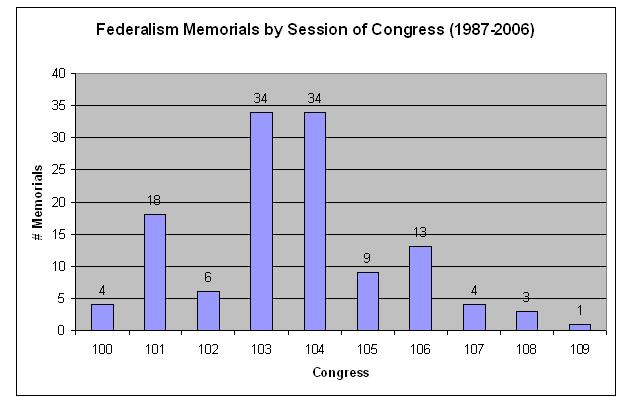
As the table below indicates, these federalism memorials appear to come in waves. The mid 1990s were a period where state criticism of  the federal government reached a critical mass.

Federalism Memorials by Session of Congress (1987-2006)

State officials shared a bipartisan sense of displeasure with the federal government during the 1990s. It remains to be seen whether the current wave of anti-Washington resolutions also crosses party lines or only comes from states with insurgent Tea Party movements in their state legislatures.

For more on the research please see our article in State and Local Government Review. For more on the methodology please see the Policy Agendas Project and the Pennsylvania Policy Database Project at Temple University.