On Balance, Legalizing Marijuana Makes Sense

by Ashley Bidne

Widener University Political Science/Criminal Justice Major

Washington is now the second state to legalize the possession of marijuana. The new law decriminalizes possession of up to an ounce. However, users must be at least 21 and selling it still remains illegal. For a long time I have been against legalizing marijuana, but with more states legalizing it I feel that now is a great time to reexamine the issue.

Colorado’s Representative Jared Polis and Oregon’s Representative Earl Blumenauer are fighting to get marijuana legalized federally. In addition, economists are claiming that Washington and Colorado could receive an economic boost of up $550 million a year. According to the FBI, possession of marijuana is the cause of 43.3% of drug related arrests. With this in mind a majority of these criminals are being sent to prison along with our tax dollars. Incarcerating one inmate could cost between $30,000 and $60,000 a year depending on the state.

However, many people are not convinced that this is a sufficient reason to legalize marijuana. Therefore, I researched further into the side effects of smoking. The health effects of marijuana include, but are not limited to mental illnesses such as depression, lung irritation, and an increased heart rate. However, many of these side effects are common with drinking alcohol and smoking cigarettes.

If the federal government chooses to legalize marijuana, the US will be capable of regulating it and will no longer be paying to incarcerate 1000’s of inmates. Overall, the benefits seem to outweigh the cost of legalizing marijuana and my decision about legalizing marijuana has been changed with Washington’s legalization.

Will Romney Pick a Governor for VP?

Pundits are floating the names of several governors (or ex-governors) as potential Vice Presidential candidates for Mitt Romney. The most prominent prospects are Chris Christie of NJ, Bob McDonnell of Virginia and Tim Pawlenty of MN. A second tier consists of Nikki Haley of SC, Susana Martinez of NM, Jeb Bush of FL, Brian Sandoval of NV and Bobby Jindal of LA. Another, Mitch Daniels of IN has accepted the post of President of Purdue University so he is no longer part of the VP-stakes.  Here’s my take on who will get the nod (courtesy of the Widener University PR Department):

Super Tuesday, State Rules for Delegate Selection & the Republican Primaries

by J. Wesley Leckrone

Assistant Professor Political Science, Widener University

With Super Tuesday right around the corner, Widener’s PR Department interviewed me concerning the Republican nomination process. Here are two videos discussing the inability of one candidate to emerge from the GOP field and the role of the delegate selection process in leading to a protracted primary season.

Philadelphia Corruption and Political Culture

The most recent corruption scandal in Philadelphia went public last week after the mayor’s Chief Integrity Officer released a report showing that a powerful State Senator and the head of the city’s School Reform Commission intervened in awarding a contract to run a local high school (for the full report click here).

Philadelphia has attempted to upgrade some of its worst performing schools by outsourcing their operation to private firms. The school district attempted to keep parents and community members involved in awarding charter school contracts by creating School Advisory Councils (SAC) for each institution. The SACs were tasked with evaluating potential firms and making a recommendation to the school district, with the Philadelphia School Reform Commission (SRC) having the final say on who got the contract.

In the case of Martin Luther King High School both the SAC and former school district Superintendent Arlene Ackerman supported giving Mosaica the contract to run the school. However, State Senator Dwight Evans intervened on behalf of another education company, Foundations, with which he had a long established relationship (including the receipt of political contributions from its employees).  After the SRC approved Mosaica for the job over his objections he held a meeting with one of the firm’s representatives and former SRC chair  Robert Archie that was described in the report as being “[l]ike a scene from the Godfather.” Archie, who had recused himself from voting on the issue because his law firm does business with Foundations, none-the-less called the meeting to dissuade Mosaica from taking the contract. During the meeting Evans threatened to withhold community support so that Mosaica’s reforms at MLK High School would fail. Evans characterized his performance at the meeting as being like “a dog on the bone”. The following day Mosaica dropped its bid for the contract and Foundations was the only remaining firm in the competition.

There has been a pattern of this sort of politics in Philadelphia (see this article from the Inquirer). The use of naked power politics by Evans to achieve his objectives was disconcerting. However, the responses from members of Philadelphia City Council were even more distressing (see this article from the Inquirer).

Councilwoman Marian Tasco:

“People had a meeting, and they disagreed. It’s a disagreement. Folks fight for their point of view. What’s wrong with that?”

Councilman James F. Kenney:

“Public officials do advocate on the part of businesses.”

Councilman Frank Rizzo:

“Sometimes the most powerful survive. That’s what politics is all about. Powerful people have the ability to deliver projects. . . . Dwight was – is still – a powerful politician. Dwight used that power to be helpful to a legitimate organization. There’s nothing wrong with that.”

Zack Stalberg, the president of good government group Committee of Seventy understands the cynicism behind these comments:

“Real people, as opposed to people too comfortable with the way the political system works, are outraged by what seems to have gone on in this situation,” he said. “And I think they will not be happy with the nonchalant remarks of these City Council members.”

Corruption can occur in any community. However, the tolerance, and even acceptance of a political system based on cronyism and self-interest by Philadelphia’s elected officials separates the city from other polities. Daniel Elazar’s classic book American Federalism: A View from the States provides insight into why the political class behaves this way.

In the book Elazar develops a model of political culture that has become a standard explanation of why different states or regions of the country have varying beliefs concerning the objectives and operation of government. He argues that the country is divided into three political subcultures: individualistic, moralistic and traditionalistic. The individualistic political culture sees politics as a marketplace of competing individual interests who use the political system to better their own causes. The moralistic culture believes that collective action through politics is the highest calling and that participation in politics and the betterment of the greater good are the objectives of government. Finally, governments in the traditionalistic culture are designed to preserve the status quo and benefit elites.

Not surprisingly, Elazar (who taught at Temple University) categorized Pennsylvania and Philadelphia in the individualistic political culture. A further parsing of his explanations shows the subculture is a perfect fit for Philadelphia politics. Elazar claims that:

“The individualistic political culture holds politics to be just another means by which individuals may improve themselves socially and economically. In this sense politics is a ‘business’ like any other that competes for talent and offers rewards to those who take it up as a career.”

Some officials in the individualistic culture “believe that an officeholder’s primary responsibility is to serve himself and those who have supported him directly, favoring them even at the expense of others.”

In the individualistic political culture

“[b]oth politicians and citizens look upon political activity as a specialized one, essentially the province of professionals…and no place for amateurs to play an active role. Furthermore, there is a strong tendency among the public to believe that politics is a dirty – if necessary – business, better left to those who are willing to soil themselves by engaging in it.”

These expectations ratchet down our expectations for government.

 “Since a fair amount of corruption is expected in the normal course of things, there is relatively little popular excitement when any is found unless it is of an extraordinary character. It is as if the public is willing to pay a surcharge for services rendered and only rebels when it feels the surcharge has become too heavy.”

The problem is that political cultures are embedded in a polity and are very slow to change. While Mayor Nutter and his Chief Integrity Officer are trying to alter the way politics are practiced in Philadelphia they are unlikely to create systemic change in the short term. For as Councilwomen Tasco stated: “The landscape is what it is. Next week it will be something else.”

See also:

Karen Heller: A primer on politics, but don’t let the kids look

Poll: A ‘Godfather’ Moment Highlights City’s Political Culture

The Founders and State Representation in Congress

A number of commentators are supporting reforms designed to give state legislatures more authority over their congressional delegations. These are rooted in a concern that the federal government has preempted too much state authority and imposed expensive unfunded mandates. In a future post I will examine the most popular of these proposals: the repeal of the 17th Amendment (direct election of U.S. Senators). However, to start the conversation about the utility of potential reforms I thought it might be interesting to return to some of the Founders’ thoughts on who should have the most control over members of Congress: the states or the representatives’ constituents.

One interesting insight into this question is a debate over whether members of the new “national legislature” should be compensated by the states or the new federal government. The following deliberations come from James Madison’s Notes on the Debates in the Federal Convention of 1787.

Supporters of letting the states provide compensation argued that there were different standards of living throughout the country and that individual states would be the best judges of a salary. A less benign argument claimed that the interests of the poorer states would be different than those of the “old States” and the latter should not have to “pay the expenses of men who would be employed in thwarting their measures and interests”.

This rationale that Congress would be nothing more than a battleground for the naked interests of individual state legislatures was rejected by the rest of the Convention.  Edmund Randolph (VA) argued that “if the States were to pay the members of the National Legislature, a dependence would be created that would vitiate the whole System. The whole nation has an interest in the attendance & services of the members.” James Wilson (PA) “thought it of great moment that the members of the National Government should be left as independent as possible of the State Governments in all respects.” Alexander Hamilton (NY) concurred and “was strenuous against making the National Council dependent on the Legislative rewards of the States. Those who pay are the masters of those who are paid.” Alexander Hamilton distinguished between “the feelings and views of the people – and the Governments of the States arising from the personal interest and official inducements which must render the latter unfriendly to the General Government” (italics in original).

The aforementioned comments are derived from the debate about pay for the House of Representatives. What about the state-based Senate whose members were originally chosen by state legislatures? An amendment to have Senator’s salaries funded by the states was rejected by the Convention.  James Madison (VA) argued that this would make the Senate “mere Agents & Advocates of State interests & views, instead of being the impartial umpires & Guardians of justice and general Good.”

The debate over pay is only one aspect of the Founder’s vision for state representation in Congress. However, it shows that they envisioned a national legislature that would rise above the parochial interests of individual state legislatures and deliberate on a common good for the whole country. The House was designed to respond to the needs of its citizens, rather than individual state legislatures, and even the state-based Senate was expected to be objective when considering conflicts between states.

The Outlook for 2012 State Budgets

The National Governors Association (NGA) and the National Association of State Budget Officers (NASBO) released their Spring 2011 Fiscal Survey of the States yesterday. The Survey provides aggregate and individual state data on general fund revenues, expenditures and balances. As such it serves as a good barometer of the fiscal health of state governments and highlights existing and future trends in state budgeting.

The study shows mixed trends for states given that  their revenues generally lag behind national economic recoveries. The Fiscal Survey argues that

states face numerous fiscal challenges as they enter fiscal 2012 including the withdrawal of significant funding that was provided through the American Recovery and Reinvestment Act of 2009 (ARRA). As unemployment remains elevated and consumer spending remains soft, state revenue collections continue to be affected by the economic downturn while at the same time pressure for state spending in areas such as healthcare and education con­tinues to grow.

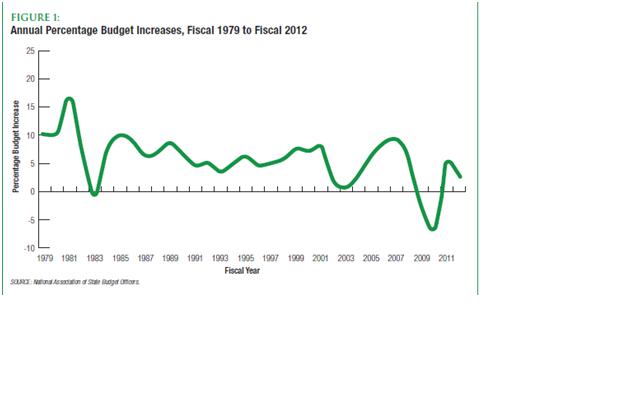
After declines in 2009 and 2010, revenues and expenditures increased in 2011 and will again in 2012 (see chart below).

The upturn means that 40 states will have higher general fund budgets in fiscal 2012 than in the previous year. Even with this improvement, aggregate spending among all states and 29 individual states is still below 2008 levels.

Many states face continued shortfalls in revenue. The study states that

for fiscal 2011, 22 states are exceeding original forecasts, while 11 are on target, and 17 states are below forecasts. This suggests that some states could finish fiscal 2011 with slight surpluses. While any surplus is a positive sign, such surpluses are more likely the result of cuts in spend­ing from previous fiscal years as well as conservative revenue forecasts.

While the Fiscal Survey does not discuss how these surpluses may be used, the politics surrounding lowering taxes or restoring funding to programs that have been cut has the potential for partisan conflict (see the current situation in Pennsylvania).

The future does not look good either:

Although not all state budget offices have completed forecasts, thus far 33 states are reporting $75.1 billion in budget gaps for fiscal 2012 and 21 states are reporting $61.8 billion in budget gaps for fiscal 2013.

Twelve states are proposing net tax increases to help solve the budget gaps, which is down from 24 in fiscal year 2011. As indicated by the figure below, this follows the historical trend of tax increases in the immediate aftermath of a recession.

Seventeen states are proposing across the board cuts to balance their 2012 budgets, while 38 states are looking at targeted budget cuts with higher education, K-12 education, and public assistance at the top of the list of policies with declining expenditures. Other strategies to breach the budget gaps include agency reorganization (22 states), local aid reductions (18 states), cuts to state employee benefits (17 states) and layoffs (15 states).

Overall the Spring 2011 Fiscal Survey of the States shows improved trends from the depths of the recent recession. Many states still face difficult budget problems in the coming years. However, the historical data provided by the Fiscal Survey shows that states should be in a better fiscal state in the years to come.