Youngsters Not So Fired Up

By Amanda Raimer

Widener University American Government Student

In the New York Times article, “Idealism Harder to Find From Younger Voters”, it talks about reasons why the younger generation does not seem as excited about this election as the last. What the article found is that this demographic is focusing more on the details and facts behind each candidate rather than just their feel-good message as they promise prosperity and success in the future. At the same time, others are having a hard time connecting to either candidate and either find a trivial reason to back one of the candidates or choose not to vote at all. More or less what I got from this article is that young voters are having a hard time finding a reason to stand behind one candidate or the other, and this is leading to confusion.

As I was filling out my absentee ballot I had the same kind of feeling; I thought I knew who I was going to vote for but I was surprised to find that I was doubting myself because I didn’t really feel passionate about either candidate like I thought I would. I started to wonder why I and other young Americans like myself were running into this uncertainty, especially so close to the election. I think what has happened is this election is less focused on social issues, which most young people know a lot about, and more on financial and policy issues. These issues are important but they’re very hard to understand for a generation whom a majority of them are just starting to become independent and fiscally responsible. Trying to wade through all the jargon and facts and background to understand exactly what the candidates are supporting in their campaign is quite a task, one that many younger people don’t feel the need to do or give up on. Also, at this time in their lives, young people are still developing their ideals and values and trying to pick a candidate based on their principles when you are not sure of your own is difficult. So while I think that it is important to vote and be heard, I can understand how this confusion and uncertainty could lead a person to not vote at all.

Romney’s Loss?

by Bridget Hicks

Widener University American Government Student

Election day is tomorrow and voters seem to be siding with President Obama, at least on the east coast. In the aftermath of Sandy’s tragic visit, Obama seems to be the only feasible candidate for to help the country. After the hurricane, the east coast, especially in my home state of New Jersey, was devastated. How is it possible for Governor Christy to spearhead the state’s recovery alone?

Obama paid a visit to the places destroyed by Hurricane Sandy to present his support for the recovery of the towns and people who were distraught by this storm. He came to lend a helping hand to Governor Christy. Where was the other candidate? Where was Governor Romney?

Romney is staying strong with his word. Romney supports more state power, with smaller federal government power. He believes the states should be in charge of disaster recovery. As an in-land resident of New Jersey I was fortunate not to experience the complete and utter destruction in the coastal areas. However, my home, as well as others around me, also experienced destruction. Seeing President Obama going around to New Jersey citizens and offering his support was comforting. Obama is someone I would want to see leading the country. He is a man who is here to help in times of need and does not just assume his role to give states powers that he should also take responsibility for. With the election so close, this trip to New Jersey for Obama was a huge help not only to gain support from the people of the east coast but everywhere. When people hear of this, they think “what would I expect if I were in that situation?” They would want a president who is there for them and ready to come help. Romney seriously damaged his campaign by not coming over to the east coast and acknowledging this disaster while Obama capitalized on this opportunity.

The Electoral College, Federalism and the Small State Bonus, Part 1

by J. Wesley Leckrone

Assistant Professor of Political Science, Widener University

The 2012 presidential race is close enough that some pundits are predicting the winner of the Electoral College (EC) will differ from the popular vote. Whether or not this happens, there will likely be a post-election debate about the utility of the EC and whether it contradicts notions of democracy in the 21st century.

There are numerous arguments against the Electoral College (see The National Popular Vote for a list).  One of the most contentious is whether the “federalism bonus” gives too much representation to small states. Randall Adkins and Kent Kirwan address this issue in their 2002 article “What Role Does the ‘Federalism Bonus’ Play in Presidential Selection” (Publius: The Journal of Federalism). They address why the Founders created the Electoral College, whether it actually has any effects on the outcomes of presidential elections, and whether there is any chance of reforming  or abolishing the EC given our constitutional amendment process. I’ll address how the “Federalism Bonus” has affected presidential elections in this post and explore their other arguments in future blogs.

Adkins and Kirwan argue that

“If each state receives a number of presidential electors equal to that state’s number of members in the U.S. House of Representatives plus the two senators, then the ‘federalism bonus’ represents the two electoral college votes that correspond to the position of each state as an equal entity in the Senate.”

This has been criticized by contentions that

“the ‘federalism bonus’ causes a distortion of the popular vote, leading to unequal representation by providing  disproportionate influence into the citizens of small states. For example, in the 2000 presidential election, each of Wyoming’s three electors ‘represented’ 151,196 persons in the state. At the other extreme, each of California’s 54 electors represented some 551,112 persons.”

The authors examined all elections between 1856 and 2000 to see if the “federalism bonus” played any part in the outcome of the Electoral College vote. To do this they compared the EC vote under the existing system and then created another EC vote that subtracted the EC electors attributed to a state’s Senators (i.e a state with only one House member and two Senators would normally receive three electoral votes. However, minus the “federalism bonus” they would receive only one).

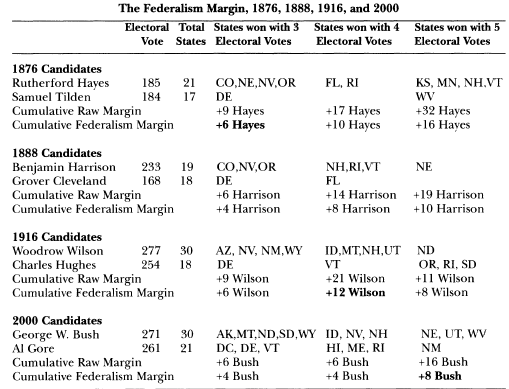
They found that there were only three elections where the “federalism bonus” influenced the outcome of a presidential election: 1876, 1916, and 2000. Missing from this list is the 1888 election between Cleveland and Harrison that was decided by the EC. The 1916 election is not typically an election associated with a divergence between the EC and the popular vote, but Adkins and Kirwan show that absent the “federalism bonus” Hughes would have defeated Wilson.  The chart below shows the stats on these elections:

Here is the breakdown of how small states affected the EC vote in these elections.

Adkins and Kirwan have two meaningful conclusions about this data. First, between 1856-2000 only 3 of 37 elections were affected by the “federalism bonus” (8.1%). Second

“[w]hile two-thirds of the states enjoy some degree of over-representation in the electoral college… the states with only three to five electoral votes often represent the margin of victory in these very close elections.”

A future blog will explore the authors’ arguments as to why it is unlikely these states will give up their “federalism bonus” through a change in the EC.

Where is Obama’s Charisma?

By Ryan Devine

Widener University American Government Student

Jim Rutenberg recently penned an article depicting President Obama’s current campaign headquarters, strategy and enthusiasm.  Rutenberg’s article paints a picture of a very methodical, down to earth campaign committee that is working feverishly and with a slight air of desperation due to the recent surge by Governor Romney.  This stands in stark contrast to his 2008 campaign that became as much a pop-culture movement as it did a political one.  The boardwalks up and down the coast were littered with “Yes We Can” t-shirts and the iconic “Change” posters of Obama infiltrated every walk of life.  These gimmicks that then Senator Obama employed fueled him to a convincing win that never really seemed all that close in the waning weeks of the 2008 election.  However, this time around the possibility of defeat appears to be very real.  President Obama lived and died with the charismatic showman persona throughout his first run at presidency and, due to his natural talents, beat Senator John McCain.

President Obama seems to have abandoned that approach for the most part though and I have to believe it is a major factor in his inability to put Romney away before the debates and played a key role in his embarrassing performance in the first debate.  Essentially, he is playing a game that suits Mitt Romney’s strengths.  This year’s election seems to be a more classical campaign from both sides without the fanfare that Obama drew in ’08.  This has been a he advantage for Mitt Romney who comedian and political talking head John Stewart described as what you would get if you asked for a president to be shipped to you in a box, in terms of his appearance and his actions, while speaking with Bill O’Reilly on “The O’Reilly factor” in 2011.  Barack Obama’s inability to make himself the biggest celebrity in the world for a second time has clearly held back his ability to take control of this election.  Unless he can turn back the clock and really energize the nation around his image in the next two weeks, he is going have a very difficult time beating out Mitt Romney.

The Impact of Images in 2012 Presidential Advertising

by Amanda Raimer

Widener University American Government Student

A New York Times article, “Images, Themes and Props in Presidential Campaign Ads”, listed statistics about the kinds of subjects that were contained in the different ads for each party and how they were used in the ads. While many of the statistics were similar between the parties, there were a few that were glaringly different. For instance, only 1% of Obama’s campaign ads show “tears or visually sad” subjects, while 21% of Romney’s ads focused on this pertaining mostly to unemployment and taxes. This makes sense in that Obama is attempting to focus on the positive parts of his past four years and reminding people of their hardships will remind them that it was under during his presidency that these things happened; Romney is using these hardships against Obama to convince voters they don’t want another four years like the past four.

Another drastic difference showed in the number of ads that focused on the elderly, with Obama having 38 ads and Romney only having two. I thought this was interesting because senior citizens are normally thought to be majority Republicans, so then why didn’t seniors appear in more of those ads? It is possible that the Romney campaign believes they have already secured the vote of the elderly and don’t want to waste money, but the Obama campaign is trying to sway more elderly to vote Democrat and so includes more seniors in their ads so that this population feels included under the Obama administration.

One statistic that I thought was interesting was that Obama not only used the American flag in his ads 5 times as much as Romney, but he also made the flag appear in a positive light, while Romney sometimes showed the flag as damaged or burning. In this case I think that Obama has the right idea on this strategy. Romney is trying to show that under Obama we are not safe and the country is disintegrating, but at the same time he should try to also use the flag in a positive light while talking about the American future under his presidency. I feel like positive and progressive outlooks are more effective than just looking at the past and only talking about what went wrong in the past.

Overall these statistics showed me how the candidates use different subjects to evoke certain emotions in their audiences. Even the same subject matter can be utilized to provoke very different reactions depending on the context. This article gave me insight into what the candidates are most concerned about and their strategies for dealing with those issues.

Are Debates Really Important?

by Danny Griffin

Widener University American Government Student

Television debates were first introduced in 1960 and have played a significant part in the election process.  Voters have felt that they can learn much more about a candidate from watching him on TV than reading about him in a newspaper article. However, some people feel that news organizations downplay the role of debates in elections. An interesting theory behind the lack of “hype” is that it is much more exciting for viewers to discover a story from the unexpected than for people to get what they expect. The author of an article regarding the current presidential debates calls the phenomenon “Hype against Hype” (CSMonitor).

Regardless of media ploys, the debates are a good source of information for voters to inform themselves on the candidates they will be choosing between. Personally, I know that I am not well versed in the finer points of Obama or Romney’s campaign platforms. By watching tonight’s debate I will be able to make a more enlightened decision with more confidence. I am also sure that I am not the only American in my position; debates are a major pillar of campaign momentum. Therefore, many people such as myself will be compelled to watch and develop a better understanding of the upcoming political situation.