Two Views on the Secession Petitions

The following are two opinions of the petition drive for Secession by Widener University American Government Students Danny Griffin and Erica Sharp:

A Divided America

Danny Griffin

A surprising amount of Americans have signed petitions to secede from the United States in recent weeks. The online proposition has found the most popularity in Texas, attaining over 100,000 signatures. The petition has versions founded by supporters in all 50 states, however. Some people feel that those who have signed the petition should be stripped of their citizenship and deported, while others assert that these people should be allowed to secede as long as they pay their share of the national debt.

In my opinion, I find the statements about stripping citizenship of the political dissenters to be outrageous. How can such harsh treatment for free speech be justified? If such a course of action was ever taken, what kind of example would it serve as to others? People would be terrified to speak out against government. This nation was founded on the principle that the people should be able to voice their opinions without fear of any repercussions from the government.

As for the statement about paying a share of the national debt, I also find it to be deluded. Many of these people are probably signing the petition simply to voice their disgust at President Obama winning a second term. Therefore, they most likely voted for Romney, which in their eyes would have significantly helped reduce debt. In effect, these people would feel that they did their part already in attempting to negate national debt.

In regard to the entire situation, I see nothing wrong. I am doubtful that many of these people are serious about seceding from the US; they just hope to see a change in the way the country is being run. If these citizens especially did not want to be a part of America anymore, they move and relinquish citizenship. I see the acts as perfectly valid executions of free speech.

Will We Secede Again?

Erica Sharp

Throughout an election there are some that are in full support of either their candidate or their political party. It seems some people have taken this idea to the extreme, most people have heard or seen someone state that, “if so and so doesn’t win the election I’m moving to Canada.” This idea is completely irrelevant and is just some people’s simplistic way of showing how they feel when their candidate does not win. Unfortunately, this was not the case this presidential election period. Citizens have returned back to the old idea of if we don’t agree with who’s running the government and his ideas we should have our state secede from the Union. As we know this idea worked extremely well the last time it was implemented, leading our nation into a Civil War.

So which states feel this way and what do they want to happen and why? The list of states continues to rise, now consisting of, Alabama, Arkansas, Colorado, Florida, Georgia, Indiana, Kentucky, Louisiana, Michigan, Mississippi, Missouri, Montana, New Jersey, New York, North Carolina, North Dakota, Oregon, South Carolina, Tennessee and Texas. Their idea is that they want to withdraw formally from the membership of our federal union. People from these states have begun supporting petitions to secede from the U.S. right after the President was announced to win himself a second term in office. They need to gain at least 25,000 signatures in 30 days or less for the administration to grant a formal review. As of right now Texas seems to be the closest to its goal with 23,000 signatures already. But then getting back to it why do they want to secede in the first place? It seems these people that are petitioning truly believe that this government has become in their mind “destructive,” and they see it as there right as American citizens to alter or abolish it and create a new form of government.

This idea and the large support being shown towards it is beginning to scare some of the other citizens of this nations. The fears should really be put to rest right now because as it is seen these states are very reliant, probably more than they know, on the government and what it does for them. Without this help these states wouldn’t survive. So although there is always that slim chance of a state seceding it shouldn’t be a main concern for now.

Romney’s Loss?

by Bridget Hicks

Widener University American Government Student

Election day is tomorrow and voters seem to be siding with President Obama, at least on the east coast. In the aftermath of Sandy’s tragic visit, Obama seems to be the only feasible candidate for to help the country. After the hurricane, the east coast, especially in my home state of New Jersey, was devastated. How is it possible for Governor Christy to spearhead the state’s recovery alone?

Obama paid a visit to the places destroyed by Hurricane Sandy to present his support for the recovery of the towns and people who were distraught by this storm. He came to lend a helping hand to Governor Christy. Where was the other candidate? Where was Governor Romney?

Romney is staying strong with his word. Romney supports more state power, with smaller federal government power. He believes the states should be in charge of disaster recovery. As an in-land resident of New Jersey I was fortunate not to experience the complete and utter destruction in the coastal areas. However, my home, as well as others around me, also experienced destruction. Seeing President Obama going around to New Jersey citizens and offering his support was comforting. Obama is someone I would want to see leading the country. He is a man who is here to help in times of need and does not just assume his role to give states powers that he should also take responsibility for. With the election so close, this trip to New Jersey for Obama was a huge help not only to gain support from the people of the east coast but everywhere. When people hear of this, they think “what would I expect if I were in that situation?” They would want a president who is there for them and ready to come help. Romney seriously damaged his campaign by not coming over to the east coast and acknowledging this disaster while Obama capitalized on this opportunity.

The Electoral College, Federalism and the Small State Bonus, Part 1

by J. Wesley Leckrone

Assistant Professor of Political Science, Widener University

The 2012 presidential race is close enough that some pundits are predicting the winner of the Electoral College (EC) will differ from the popular vote. Whether or not this happens, there will likely be a post-election debate about the utility of the EC and whether it contradicts notions of democracy in the 21st century.

There are numerous arguments against the Electoral College (see The National Popular Vote for a list).  One of the most contentious is whether the “federalism bonus” gives too much representation to small states. Randall Adkins and Kent Kirwan address this issue in their 2002 article “What Role Does the ‘Federalism Bonus’ Play in Presidential Selection” (Publius: The Journal of Federalism). They address why the Founders created the Electoral College, whether it actually has any effects on the outcomes of presidential elections, and whether there is any chance of reforming  or abolishing the EC given our constitutional amendment process. I’ll address how the “Federalism Bonus” has affected presidential elections in this post and explore their other arguments in future blogs.

Adkins and Kirwan argue that

“If each state receives a number of presidential electors equal to that state’s number of members in the U.S. House of Representatives plus the two senators, then the ‘federalism bonus’ represents the two electoral college votes that correspond to the position of each state as an equal entity in the Senate.”

This has been criticized by contentions that

“the ‘federalism bonus’ causes a distortion of the popular vote, leading to unequal representation by providing  disproportionate influence into the citizens of small states. For example, in the 2000 presidential election, each of Wyoming’s three electors ‘represented’ 151,196 persons in the state. At the other extreme, each of California’s 54 electors represented some 551,112 persons.”

The authors examined all elections between 1856 and 2000 to see if the “federalism bonus” played any part in the outcome of the Electoral College vote. To do this they compared the EC vote under the existing system and then created another EC vote that subtracted the EC electors attributed to a state’s Senators (i.e a state with only one House member and two Senators would normally receive three electoral votes. However, minus the “federalism bonus” they would receive only one).

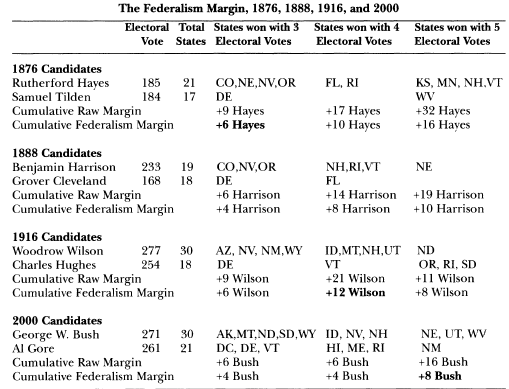
They found that there were only three elections where the “federalism bonus” influenced the outcome of a presidential election: 1876, 1916, and 2000. Missing from this list is the 1888 election between Cleveland and Harrison that was decided by the EC. The 1916 election is not typically an election associated with a divergence between the EC and the popular vote, but Adkins and Kirwan show that absent the “federalism bonus” Hughes would have defeated Wilson.  The chart below shows the stats on these elections:

Here is the breakdown of how small states affected the EC vote in these elections.

Adkins and Kirwan have two meaningful conclusions about this data. First, between 1856-2000 only 3 of 37 elections were affected by the “federalism bonus” (8.1%). Second

“[w]hile two-thirds of the states enjoy some degree of over-representation in the electoral college… the states with only three to five electoral votes often represent the margin of victory in these very close elections.”

A future blog will explore the authors’ arguments as to why it is unlikely these states will give up their “federalism bonus” through a change in the EC.

More of the Same? Or Romney’s 50 Nation Plan?

by Tori Remondelli

Widener University American Government Student

The first presidential debate was between an eloquent, enthusiastic speaker who beat around the bush and a supposed lock for the presidency who didn’t prepare as well as he should have. Mr. Romney, former governor of what he made out to be the best state in America, wants to give more power to each individual state in an effort to try and make them a little more like Massachusetts. It wasn’t very clear what Mr. President’s counter proposal was, so we can assume that nothing will change.

My mother who is a born and bred Republican believes that if you don’t like the way your state is run, then you should be able to move to a different state where the control will be different. But if the government sets regulations that every state must abide by, then you have no choice but to throw your vote into a pool of every American voter and pray you pick the same as the majority.

What I got from that debate was a choice between President Change’s same old ways or Romney’s 50 Nations policy. However, neither provided the details of their plan.  A choice is only as good as the reasons behind it and right now neither one of the candidate have provided enough reasons to merit one. Hopefully the next debate will bring more clarity, but only time will tell.

Federalism & the 2012 Vice Presidential Debate

Unlike the first presidential debate which included a number of issues relating to federalism and state and local politics – the VP debate did not address federalism. There was no real debate on education, medicaid or the health care reform. Consequently – we’ll have to wait until next Tuesday to discuss the issues related to this blog.

Will Romney Pick a Governor for VP?

Pundits are floating the names of several governors (or ex-governors) as potential Vice Presidential candidates for Mitt Romney. The most prominent prospects are Chris Christie of NJ, Bob McDonnell of Virginia and Tim Pawlenty of MN. A second tier consists of Nikki Haley of SC, Susana Martinez of NM, Jeb Bush of FL, Brian Sandoval of NV and Bobby Jindal of LA. Another, Mitch Daniels of IN has accepted the post of President of Purdue University so he is no longer part of the VP-stakes.  Here’s my take on who will get the nod (courtesy of the Widener University PR Department):