
Federalism and Public Opinion

by J. Wesley Leckrone

Assistant Professor of Political Science, Widener University

Two recent polls by the Pew Research Center show that state and local governments are viewed more favorably than their federal counterparts. The first poll, conducted in April, showed favorability was 61% for local government, 52% for states and 33% for the federal government. Favorable views for all governments have declined over the last decade, but the decline for Washington, DC has been especially steep. In 2002 support for each level of government was clustered in the 60% range.

When asked to rate states and federal government on specific characteristics the states garner more support. However, both levels of government are viewed with skepticism.

Following previous public opinion polling, there is a partisan divide on which level of government is viewed more favorably. Satisfaction is related to congruence between individual partisan affiliation and the partisan composition of the level of government. Democrats had a 29% favorability rating for the federal government in the last year of the Bush Administration. With Obama in the White House Democrats currently have a 51% favorability rating for the federal government. Republican support for Washington, DC has declined from 53% to 20% over the same period.

Republicans are generally more supportive of state government. However, this appears to be related to the partisan control of their state capitals. 70% of Republicans support state government when the governor and legislature are controlled by their party. Support declines to 33% when Democrats control their state government.

A separate survey by the Pew Research Center (The 2012 Values Survey) shows a little more stability in people’s perception of the intergovernmental balance of power in the United States. 69% of Americans agree with the statement “the federal government should run only those things that cannot be run at the local level.” Republicans (especially conservative Republicans) have held remarkably steady in their support for this statement. Conversely Democratic support for decentralization appears to be more related to the President’s party.

The Pew polling seems to reinforce the notion that federalism is a secondary value to the ideological predispositions of Americans. While Americans have a tendency to support decentralized government, they are also prone to vary their support for different levels of government depending on the congruence between officials in power and their own partisanship.
In Vitro Fertilization, Social Security and Federalism

by J. Wesley Leckrone

Assistant Professor of Political Science, Widener University

Yesterday the United States Supreme Court tackled the issue of whether children conceived via in vitro fertilization after a father’s death are eligible for Social Security.

The case involved twin children conceived by Karen Capato through in vitro fertilization after her husband’s death from cancer.  Her husband had preserved his sperm after being diagnosed with cancer because he feared the cancer treatment would make him sterile. He and his wife wanted to add to their family. However, he died shortly afterwards and his wife conceived the twins about 18 months after his death. (NPR – Nina Totenberg)

Karen Capato applied for Social Security survivor benefits for the twins but was denied.

According to the SSA, children are entitled to benefits from a wage earner who dies if they qualify for inheritance under state law. In Florida [where the Capatos lived at the time of death], a child may not inherit through intestate succession unless conceived while the deceased parent was still alive. (ABA Journal – Debra Cassens Weiss)

In a unanimous decision the Supreme Court ruled that the twins were not eligible for benefits (click to read the text of Astrue v. Capato).  Justice Ginsburg delivered the opinion of the Court and argued that the Social Security Act often defers to state law on family status in determining eligibility for survivor benefits. She stated

Reliance on state intestacy law to determine who is a “child” thus serves the Act’s driving objective. True, the intestacy criterion yields benefits to some children outside the Act’s central concern. Intestacy laws in a number of States, as just noted, do provide for inheritance by posthumously conceived children, see supra, at 12,9 and under federal law, a child conceived shortly before her father’s death may be eligible for benefits even though she never actually received her father’s support. It was nonetheless Congress’ prerogative to legislate for the generality of cases. It did so here by employing eligibility to inherit under state intestacy law as a workable substitute for burdensome case-by-case determinations whether the child was, in fact, dependent on her father’s earnings.

Ultimately the Court used a rational basis test to uphold the Social Security Administration’s holding which allowed deference to state law. Ginsburg argued

Tragic circumstances—Robert Capato’s death before he and his wife could raise a family—gave rise to this case.But the law Congress enacted calls for resolution of Karen Capato’s application for child’s insurance benefits by reference to state intestacy law. We cannot replace that reference by creating a uniform federal rule the statute’s text scarcely supports.

In the grand scheme of federalism cases that the Court will decide on this term (Affordable Care Act, Immigration), Astrue v. Capato lacks much excitement. However, the decision allows states to craft laws on this relatively new topic. According to Justice Ginsburg, five states (California, Colorado, Iowa, Louisiana and North Dakota) have already passed laws allowing children born up to three years after a father’s death to receive benefits. It will be interesting to see if this case spurs more state legislative action on the topic and if a national consensus emerges.

Federalism and the Republican Presidential Debate

Let the pundits argue about who won the Republican debate by not losing it, who emerged as the “new” fresh face and who didn’t assert themselves strongly enough.  Since theamericanpartnership.com is devoted to the coverage of federalism issues we’ll focus on how the candidates addressed issues related to state and local government as well as intergovernmental relations. For the most part there was very little substantive debate concerning federalism – other than the federal government should get out of the way and allow states to innovate. Further, the candidates provided little detail on specific ways that states would design and implement programs differently than the federal government.

The discussion of health care policy elicited the most references to federalism with the concept of individual mandates receiving attention from a number of candidates.  Former Governor Mitt Romney (MA) gave his typical response that his healthcare plan was good for the particular circumstances in Massachusetts but would not be good for the entire country . He also announced that on his first day in office he would release an executive order directing the Secretary of the Department of Health and Human Services to grant a waiver to all fifty states allowing them to opt out of “Obamacare”. Both former Governor Jon Huntsman (UT) and businessman Herman Cain claimed that it was not appropriate for the federal government or the states to create an individual mandate for health care.

Governor Rick Perry (TX) took the most strident position on healthcare and federalism by claiming that the people of Texas would like the “federal government out of their business” and that healthcare would be a start. He argued that Medicaid should be block granted back to the states because the “one size fits all” health care mandates from DC resulted in higher costs and less effectiveness. When questioned about the large amounts of uninsured people in Texas, Perry blamed it on a lack of flexibility from the federal government in allowing the state to provide their own choices in healthcare.

The rest of the discussion of the federal government’s relations to the states was piecemeal by issue and individual candidate.  Representative Ron Paul (TX) argued in favor of devolving regulatory powers to the states. He claimed that “if you need the detailed regulations you can do it at the state level, but the federal government is not authorized to nitpick every little transaction. The way they use the Interstate Commerce clause is outrageous.” Paul claimed that he was not necessarily against regulations, he just wants them at the state level if they are going to be enacted.

Former Senator Rick Santorum (PA) argued that welfare reform was successful because it gave flexibility to the states by block granting the program and encouraging innovation. He intimated that the same could be done for other programs such as food stamps and public housing.

Perry avoided a question concerning his comment in Fed Up! That Social Security tossed aside states rights. However Romney revived this concept when he claimed that Perry’s book argued that states should be able to opt out of Social Security. Romney defended the program and argued that it should be strengthened, not eliminated.

Herman Cain seemed most inclined to turnback programs to the states, but offered little in the way of concrete proposals in how states would handle the programs better than the federal government.  He stated that the federal government was not good at “micromanaging” programs like education, Medicare or immigration. He argued for “empowering the states to do more and limit what the federal government does with those types of programs”.

Finally, former Speaker Newt Gingrich (GA) argued for more of a role for the federal government in education. He had positive statements on Obama’s Race to the Top Education program – particularly support for charter schools because they result in parental choice. He was vague as to whether he would mandate charter schools or if they would be a voluntary choice of state and local governments. Unlike Cain, he voiced no opposition to federal government being involved in educational policy.

The Founders and State Representation in Congress

A number of commentators are supporting reforms designed to give state legislatures more authority over their congressional delegations. These are rooted in a concern that the federal government has preempted too much state authority and imposed expensive unfunded mandates. In a future post I will examine the most popular of these proposals: the repeal of the 17th Amendment (direct election of U.S. Senators). However, to start the conversation about the utility of potential reforms I thought it might be interesting to return to some of the Founders’ thoughts on who should have the most control over members of Congress: the states or the representatives’ constituents.

One interesting insight into this question is a debate over whether members of the new “national legislature” should be compensated by the states or the new federal government. The following deliberations come from James Madison’s Notes on the Debates in the Federal Convention of 1787.

Supporters of letting the states provide compensation argued that there were different standards of living throughout the country and that individual states would be the best judges of a salary. A less benign argument claimed that the interests of the poorer states would be different than those of the “old States” and the latter should not have to “pay the expenses of men who would be employed in thwarting their measures and interests”.

This rationale that Congress would be nothing more than a battleground for the naked interests of individual state legislatures was rejected by the rest of the Convention.  Edmund Randolph (VA) argued that “if the States were to pay the members of the National Legislature, a dependence would be created that would vitiate the whole System. The whole nation has an interest in the attendance & services of the members.” James Wilson (PA) “thought it of great moment that the members of the National Government should be left as independent as possible of the State Governments in all respects.” Alexander Hamilton (NY) concurred and “was strenuous against making the National Council dependent on the Legislative rewards of the States. Those who pay are the masters of those who are paid.” Alexander Hamilton distinguished between “the feelings and views of the people – and the Governments of the States arising from the personal interest and official inducements which must render the latter unfriendly to the General Government” (italics in original).

The aforementioned comments are derived from the debate about pay for the House of Representatives. What about the state-based Senate whose members were originally chosen by state legislatures? An amendment to have Senator’s salaries funded by the states was rejected by the Convention.  James Madison (VA) argued that this would make the Senate “mere Agents & Advocates of State interests & views, instead of being the impartial umpires & Guardians of justice and general Good.”

The debate over pay is only one aspect of the Founder’s vision for state representation in Congress. However, it shows that they envisioned a national legislature that would rise above the parochial interests of individual state legislatures and deliberate on a common good for the whole country. The House was designed to respond to the needs of its citizens, rather than individual state legislatures, and even the state-based Senate was expected to be objective when considering conflicts between states.

Federalism, SCOTUS & Bond v. US

One of my primary objections to the National Constitution Center in Philadelphia is its emphasis on civil rights and liberties as they have evolved through the Bill of Rights and subsequent Constitutional Amendments. Obviously the federal government’s obligation to ensure citizens the right to participate equally in society and to not have their rights arbitrarily violated by the government is instrumental in preserving freedom. However, this focus is by its nature incomplete. The Founders believed that the structure of our governmental system would be the ultimate guarantor of individual liberty (see Alexander Hamilton’s discussion in Federalist 84). Representative democracy, separation of powers, checks and balances, federalism, and the extended republic were designed to preserve individual rights by “first enabl[ing] the government to control the governed; and in the next place oblige it to control itself” (Federalist 51).

This view of government structure as a tool to preserve individual liberties and rights tends to be a bit passé in contemporary discussions of American government.  Justice Kennedy’s opinion for a unanimous Supreme Court in Bond v. the United States (2011) helps breathe new life into this neglected topic.  The ruling concluded that individuals have standing to challenge federal statutes on the grounds that they interfere with powers reserved to the states (for the facts of the case please see SCOTUSblog and Oyez).

In his decision Justice Kennedy provided a primer on the relationship between governmental structure and the protection of individual rights. He stated that “If the constitutional structure of our Government that protects individual liberty is compromised, individuals who suffer otherwise justiciable injury may object.” He first turned to Supreme Court precedent that allowed individuals to invoke violations of separation of powers as an impingement of their rights.  He gives the following example:

In INS v. Chadha, 462 U. S. 919 (1983), it was an individual who successfully chal­lenged the so-called legislative veto—a procedure that Congress used in an attempt to invalidate an executive determination without presenting the measure to the President. The procedure diminished the role of the Ex­ecutive, but the challenger sought to protect not the prerogatives of the Presidency as such but rather his own right to avoid deportation under an invalid order. Chadha’s challenge was sustained. A cardinal principle of separation of powers was vindicated at the insistence of an individual….

Kennedy then applies this same logic to federalism because

The Framers concluded that allocation of powers between the National Government and the States enhances freedom, first by protecting the integrity of the governments themselves, and second by protecting the people, from whom all governmental powers are derived.

Federalism protects individual liberty in three areas according to Kennedy:

1) The federal structure allows local policies “more sensitive to the diverse needs of a heterogeneous society,” permits “innovation and experimentation,” enables greater citizen “involvement in democratic processes,” and makes gov­ernment “more responsive by putting the States in com­petition for a mobile citizenry.”

2) Federalism secures the freedom of the individual. It allows States to respond, through theenactment of positive law, to the initiative of those who seek a voice in shaping the destiny of their own times without having to rely solely upon the political processes that control a remote central power.

And

3) Federalism also protects the liberty of all persons within a State by ensuring that laws enacted in excess of dele­gated governmental power cannot direct or control their actions. See ibid.  By denying any one government com­plete jurisdiction over all the concerns of public life, feder­alism protects the liberty of the individual from arbitrary power. When government acts in excess of its lawfulpowers, that liberty is at stake.

The unanimous decision in Bond v. United States was more than an arcane examination of standing to sue. Rather, it provides a means to reinvigorate our discussion of the mechanisms that preserve our individual rights and liberties. The Supreme Court has contributed greatly to this narrative by highlighting the importance of government structure and in particular federalism.

The Outlook for 2012 State Budgets

The National Governors Association (NGA) and the National Association of State Budget Officers (NASBO) released their Spring 2011 Fiscal Survey of the States yesterday. The Survey provides aggregate and individual state data on general fund revenues, expenditures and balances. As such it serves as a good barometer of the fiscal health of state governments and highlights existing and future trends in state budgeting.

The study shows mixed trends for states given that  their revenues generally lag behind national economic recoveries. The Fiscal Survey argues that

states face numerous fiscal challenges as they enter fiscal 2012 including the withdrawal of significant funding that was provided through the American Recovery and Reinvestment Act of 2009 (ARRA). As unemployment remains elevated and consumer spending remains soft, state revenue collections continue to be affected by the economic downturn while at the same time pressure for state spending in areas such as healthcare and education con­tinues to grow.

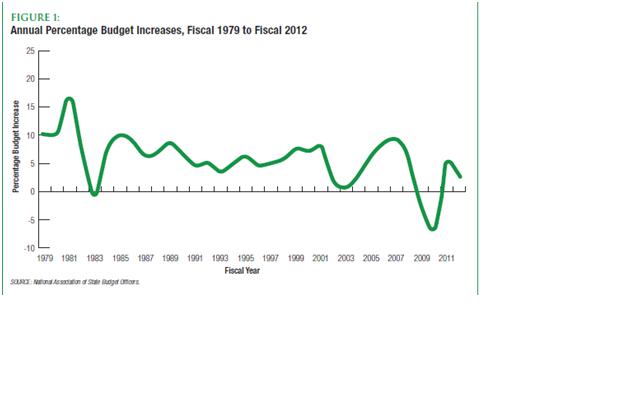
After declines in 2009 and 2010, revenues and expenditures increased in 2011 and will again in 2012 (see chart below).

The upturn means that 40 states will have higher general fund budgets in fiscal 2012 than in the previous year. Even with this improvement, aggregate spending among all states and 29 individual states is still below 2008 levels.

Many states face continued shortfalls in revenue. The study states that

for fiscal 2011, 22 states are exceeding original forecasts, while 11 are on target, and 17 states are below forecasts. This suggests that some states could finish fiscal 2011 with slight surpluses. While any surplus is a positive sign, such surpluses are more likely the result of cuts in spend­ing from previous fiscal years as well as conservative revenue forecasts.

While the Fiscal Survey does not discuss how these surpluses may be used, the politics surrounding lowering taxes or restoring funding to programs that have been cut has the potential for partisan conflict (see the current situation in Pennsylvania).

The future does not look good either:

Although not all state budget offices have completed forecasts, thus far 33 states are reporting $75.1 billion in budget gaps for fiscal 2012 and 21 states are reporting $61.8 billion in budget gaps for fiscal 2013.

Twelve states are proposing net tax increases to help solve the budget gaps, which is down from 24 in fiscal year 2011. As indicated by the figure below, this follows the historical trend of tax increases in the immediate aftermath of a recession.

Seventeen states are proposing across the board cuts to balance their 2012 budgets, while 38 states are looking at targeted budget cuts with higher education, K-12 education, and public assistance at the top of the list of policies with declining expenditures. Other strategies to breach the budget gaps include agency reorganization (22 states), local aid reductions (18 states), cuts to state employee benefits (17 states) and layoffs (15 states).

Overall the Spring 2011 Fiscal Survey of the States shows improved trends from the depths of the recent recession. Many states still face difficult budget problems in the coming years. However, the historical data provided by the Fiscal Survey shows that states should be in a better fiscal state in the years to come.