Federalism and the Gulf Oil Spill

Disasters always seem to highlight some of the difficulties inherent in our noncentralized form of American federalism.  As we commemorate the first anniversary of the disaster on the Deepwater Horizon, I thought it might be important to revisit some of the federalism issues that affected the response to the Gulf oil spill. The major issues revolved around lack of familiarity with oil spill policy jurisdiction, differing government objectives in the aftermath of the blowout, and political positioning.

Federalism, Planning , the Unified Command and The Clean-up

One major intergovernmental controversy involved control over the clean up in the immediate aftermath of the blowout.  State and local officials argued that the lines of authority were blurred between the BP response team and the Coast Guard.  Local officials felt the system was too top heavy, resulting in sluggish response times to requests and the impression that no one was in charge.  Both state and local officials claimed that the response should operate under the assumption of spend first and argue over reimbursement later. Louisiana Governor Kathleen Blanco gave voice to this sentiment when she declared that states should  “act and send them the bill and fight over it later”.

Part of the problem was that state and local officials were more accustomed to operating under the federal legislation responding to natural disasters such as hurricanes than regulations dealing with off-shore oil spills. Gulf state officials are used to operating under the Stafford Disaster Relief and Emergency Act which covers natural disasters such as hurricanes. Under this federal legislation governors request help from the federal government but the states retain primary control over the effort with FEMA assisting them. The Gulf Oil Spill was covered by the National Contingency Plan (NCP) which gives the federal government the primary responsibility for responding to the crisis. Under this legislation the federal On-Scene Coordinator acts as the primary partner with states in a Unified Command structure. State and local governments cannot spend funds without the authorization from the On-Scene Coordinator. As a consequence there was a lot of conflict between governments because of an unfamiliarity with the NCP. Throughout the process there was very little role for local governments who felt they were being kept out of the decision making process.

Economic Development vs. Long-term Environmental Clean-up

The second conflict resulted from the tension between the economic development priorities of some Gulf states and the federal government’s focus on the long-term environmental consequences of the disaster. State governments, particularly Louisiana, were interested in quick action to protect their economies based on tourism, fishing and the oil industry (13.4% of Louisiana’s employment is oil-related). In a post-Katrina environment their attitude was do something first and worry about the consequences later. Conversely, the federal government was concerned that quick solutions might exacerbate the long-term environmental consequences of the oil spill.  Needless to say, the conflict over economics also extended to the federal government’s moratorium on offshore drilling in the Gulf which state and local governments claimed would lead to job losses for their constituencies.

There was particular conflict over Louisiana’s plan to build sand berms and rock barriers to prevent oil from reaching its shores. On the one hand the state viewed their construction as a job creation tool. However, they sought to use the oil spill as a reason to begin construction of permanent berms and barriers which were part of the state’s long-term plans to address coastal restoration. For policy wonks this was a classic example of Kingdon’s policy streams where an existing solution (berms) is attached to a focusing event (oil spill) to achieve political objectives. The federal government was less sanguine concerning the construction of the berms which led to political struggle between the levels of government.

Federalism and Politics

Finally, good old-fashioned political posturing accounted for some of the conflict between governors and the federal government. Bobby Jindal was elected governor in post-Katrina Louisiana partly on his claim that he had the background to competently address natural disasters. His assertiveness on behalf of the state was an achievement heading into his 2011 reelection campaign. It should also be noted that all five Gulf states had Republican governors (Jindal, Charlie Crist – Florida, Haley Barbour – Mississippi, Bob Riley – Alabama, Rick Perry – Texas) who had no incentive to make the Obama administration look good, particularly since three of them (Barbour, Crist and Jindal) were potential presidential candidates at the time.

Models of Federalism

The intergovernmental problems related to the Gulf spill were in many ways the result of conflicting jurisdictional priorities that are endemic to our federal system. State and local governments, responsive to their electoral constituencies, were focused on ensuring the economic livelihoods of their citizens. Federal officials were responding to a national emergency and were focused on the long-term consequences of their actions as opposed to their immediate impact. In the final analysis the response to the Gulf Oil Spill could be considered an example of cooperative federalism from the vantage point of the Obama Administration while state and local governments perceived it as top-heavy coercive federalism.

Some Wisdom on Federal-State Relations

From time to time federalism becomes the topic du jour in American politics. Richard Nixon advocated a New Federalism in the 1970s, Ronald Reagan crafted another New Federalism in the 1980s and Congressional Republicans advocated for a Devolution Revolution in the 1990s. Our current political environment seems to have ushered in another of these “federalism moments”. The Tea Parties are invoking federalism and potential Republican presidential candidates are willing to follow along (Gingrich, Pawlenty, PerryRomney). Governors and state legislatures are pushing back against provisions of the Affordable Health Care Act, passing state sovereignty measures and nullification amendments,  examining ways to circumvent federal regulation through interstate compacts, and rejecting federal funds.

It is apparent that we are in the midst of our once-a-decade discussion of the virtues and drawbacks of federalism. I’d like to contribute to this debate by posting some wisdom from Morton Grodzins’ classic work on federalism The American System: A New View of Government in the United States (1966):

“The greatest complications arise when attempting to determine the locus of decision-making power. For example, it cannot be assumed that members of the national legislature or of the national executive speak only in the ‘nation’s view’ while state and local offices represent only parochial non-national views. In fact the non-national view is frequently supported by national officials, acting under a variety of influences. A analogous problem is the way in which special interest groups – date growers or electric train manufacturers, for example – will identify themselves as representing the local or state interest when the burden of their position is one of avoiding national regulation. Under such circumstances, can it be said that the state, and localities, are actually represented in the decisional process by the date growers? Even when states and localities are speaking for themselves, it is often not easy to determine whether their views are distinct from the national view. This problem is exacerbated by the universal tendency of all Americans to legitimate their actions in terms of the national interest.” (p.11)

The originator of the idea of marble cake federalism shows us that American federalism is a much more complex concept than just the interests of states versus the federal government or centralization versus decentralization. Rather it is based on a complex interplay of different governments working in tandom to solve the problems of the American people. As the dominant member of the American partnership, Washington often imposes its will on the states. However, the goal of any reform should be to realign the intergovernmental system in a way that is fair to all levels of government rather than trying to return to a dual federalism that never existed.

Anti-Washington Resolutions from States are Nothing New

States are feeling emboldened in light of the 2010 elections. Increased amounts of Republicans, particularly Tea Party backed victors, believe they have a mandate to oppose the Obama administration. Part of this is a belief that the president and the Democratic 111th Congress were too activist in their policy making. The other part is an underlying trend of states pushing back against what they believe are federal encroachments of state autonomy.

States are engaging in debate on a broad range of issues that can affect federalism, such as a “repeal” amendment, repeal of the 17th Amendment, and repeal or non-implementation of the Patient Protection and Affordable Care Act.  Some states are addressing numerous federalism issues simultaneously. For example, Blogger Craig McDermott has started a catalogue of all the anti-Washington resolutions debated in Arizona. An industrious person in Virginia could probably do the same for that state. Virginia Delegates Mark Keam and Ken Plum tweeted and editorialized about the utility of such resolutions while they were being debated.

Once passed these resolutions or constitutional amendments are forwarded to Washington. Known as memorials to Congress, the practice has predated the founding of the Republic.  The memorials are not binding on a state’s delegation, but they do provide some sense of the attitudes of states toward federal policy action.

Federalism Issues in Memorials

The 112th Congress is not unique in attracting memorials from states on federalism issues. I recently collaborated on a research project with Justin Gollob of Mesa State College that analyzed the content of memorials to Congress from 1987-2006. Most of the memorials addressed an intergovernmental issue. However, we isolated memorials that addressed the general topic of state-federal relations in the American system.

Not surprisingly, most of the memorials dealt with issues of unfunded mandates, federal preemption of states and generalized appeals to state autonomy under the 10th Amendment. The following two excerpts from Memorials were representative of the resolutions:

“Resolved by the Senate of the State of Kansas, That the Senate urges the United States Congress not to enact any laws or authorize the adoption of rules and regulations which would impose mandates upon states and local units of government therein without providing full funding for such mandates….”

“Resolved by the House of Delegates, the Senate concurring, That the Congress of the United States be hereby requested to pay greater heed to the clear restrictions placed by the 10th Amendment to the Constitution on the powers of the federal government….”

Recurring Federalism Issues (1987-2006)

Memorials that appealed to the spirit of the 10th Amendment often called for a Federalism Summit that gained traction during the mid-1990s. During this period several states also attempted to change to Constitution to allow states to initiate Constitutional amendments, thereby bypassing Congress. The ostensible purpose of this change would be to create a new federalism amendment to protect states from what they believed were encroachments of their power. Interestingly, there were few calls for increased federal transfers to states. Consequently, block grants and a return to federal revenue sharing were not popular topics of Memorials.

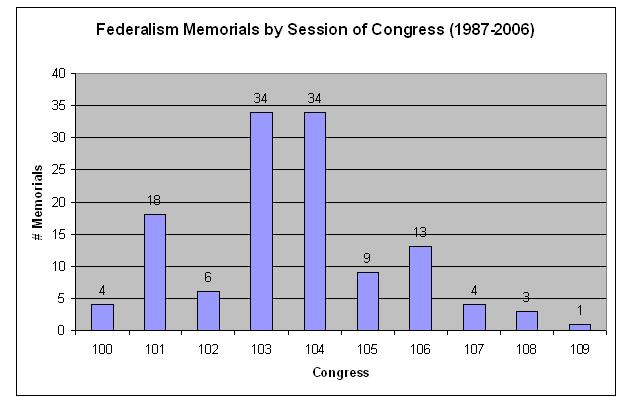
As the table below indicates, these federalism memorials appear to come in waves. The mid 1990s were a period where state criticism of  the federal government reached a critical mass.

Federalism Memorials by Session of Congress (1987-2006)

State officials shared a bipartisan sense of displeasure with the federal government during the 1990s. It remains to be seen whether the current wave of anti-Washington resolutions also crosses party lines or only comes from states with insurgent Tea Party movements in their state legislatures.

For more on the research please see our article in State and Local Government Review. For more on the methodology please see the Policy Agendas Project and the Pennsylvania Policy Database Project at Temple University.