Advocates for School Choice

by K. Braun

This Washington Post article highlights National School Choice Week (NSCW; January 22-28), advocating for school choice.*  While NSCW events were coordinated across the country, the main events took place in Washington, DC. Organizers selected the capital due to its obvious political significance and also because the District of Columbia currently has “the nation’s only federally funded voucher program.” The specific confluence of circumstances as a new Republican administration begins in 2017 makes the timing of NSCW particularly advantageous for school choice supporters.

NSCW demonstrates large-scale, concerted advocacy efforts undertaken by groups to gain or retain a place on congressional members’ legislative agendas. As the House and Senate both now have a Republican majority, school choice advocates recognize an opportunity to make significant headway on favorable legislation. Event participants can encourage legislators to act, while NSCW lobbyists can work with legislators and their staffs to propose draft bill language to enact the changes that NSCW favors.

NSCW further focused legislators’ attention by building on existing media coverage of the confirmation process of Betsy DeVos, President Trump’s education secretary nominee. Participants will likely ask their senators to vote in favor of DeVos’ confirmation, as they view her as a school choice champion. (Her past actions have involved lobbying efforts to expand voucher programs and charter schools throughout the country.) Opponents of school choice likely gather at another time within their own issue-specific organizations and lobby senators just as forcefully against school choice.

Article: Brown, Emma. “DeVos receives praise at ‘National School Choice Week’ rally.” Washington Post, 24 Jan. 2017.

* The NSCW organizers define school choice as including all education types: “traditional public schools, public charter schools, public magnet schools, private schools, online academies, and homeschooling.” However, the article treats school choice as educational options other than public school. The article does not mention the group’s organization, but its website emphasizes that it is an “independent effort” involving partners such as chambers of commerce and schools (notably absent is mention of teachers’ groups or unions).
Governor Thornburgh at Widener’s 1983 Commencement

Pennsylvania Governor Richard Thornburgh spoke at Widener University’s 162nd Commencement on May 21, 1983. His address focused on how to successfully navigate the challenges of the economic changes of the early 1980s.

His advice was to “build a new generation of competence” to adapt to “an economy in transition.” He said

“Competence — just plain old-fashioned competence — is what is most required of the generation that would make our state and nation work again. Those who display it will be the real heroes of our time.”

Thornburgh urged the students to

“Tackle the challenge of an economy in transition by working harder, thinking deeper, managing better, producing more abundantly, and caring more intensively than you ever have done before.”

In Cold War parlance he stated that “the quiet and competent heroes of this particular struggle will claim their rightful places as keepers of freedom’s flame.”

Governor Thornburgh congratulated Widener University on helping with the transition to the new economy by adding a Computer Science major for the 1983-84 academic year.

Material from this post comes from a May 21, 1983 Press Release from The Dick Thornburgh Papers at the Pennsylvania State Archives.

Governor Ridge Bet Himself in Temple-Penn State 2001 NCAA Sweet 16 Matchup

Its traditional for governors to make bets when teams from their states meet in sports championships. Former Pennsylvania Governor Tom Ridge had a number of occasions to make these wagers (see 1997 NHL Stanley Cup Finals and Super Bowl XXX). However, Governor Ridge faced a dilemma when Temple played Penn State in the 2001 NCAA Men’s Basketball Tournament. As the two teams faced off in the “Sweet 16” Ridge “raised the stakes by announcing his decision to make a bet with himself.”

A March 22, 2001 press release from Ridge describes the stakes:

“When a great Pennsylvania team is putting it all on the line, it’s the Governor’s job to step up and take a little risk himself — to stand tall and make a friendly wager in support of your team,” Gov. Ridge said. “And I’m not going to shirk that responsibility, just because Penn State [sic] and Temple are playing each other. So I’m making a bet with myself. If Temple wins, I give myself a gallon of Penn State’s famous Creamery ice cream. If Penn State wins, I’m getting myself a big ol’ Philly cheesesteak.”

The bet was especially interesting since he stated that the old cheesesteak bet was too boring during the 1997 Stanley Cup Finals between the Philadelphia Flyers and Detroit Red Wings.

Federal Dollars & State Budgets – New Pew Study

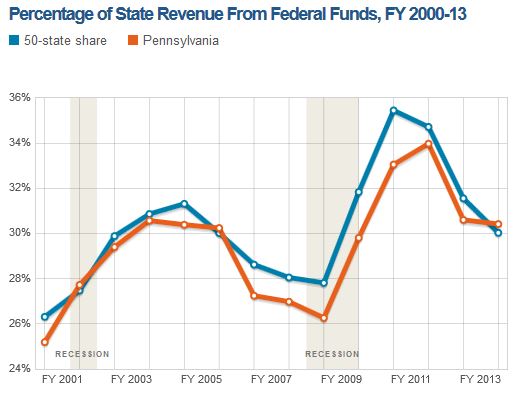
Pew States is out with a new study analyzing fiscal federalism trends in the United States. Based on data from the U.S. Census Bureau’s Annual Survey of State Government Finances they found that 30.0% of state budgets funds come from the federal government. The study states:

As the nation emerged from the Great Recession, federal dollars made up a bigger proportion of states’ revenue from fiscal year 2009 to 2012 than at any other time in the past 50 years. After peaking at 35.5 percent in fiscal 2010, however, the share fell back within its historical range in fiscal 2013, dropping to 30.0 percent.

Even at 30.0 percent, the federal share of 50-state revenue was above its 10-year prerecession average of 28.5 percent. Federal dollars remained the second-largest source of states’ money, accounting for approximately $513.5 billion of the $1.7 trillion collected by state governments in fiscal 2013.

Pennsylvania ranked 29th with 30.4% of its budget coming from the federal government. Historically Pennsylvania’s share of federal dollars as a percentage of its revenues has been slightly below average.

Pew - PA vs All States Federal Funding

Click here for the report.

Knock, Knock. Governor Wolf Drops In

Pennsylvania Governor Tom Wolf has started his term off with a series of meetings and visits with members of the state legislature. Wolf’s spokesman said he has already visited about 50 members of the legislature with plans for more. In a piece for the Philadelphia Inquirer, Amy Worden and Angela Couloumbis capture some interesting responses from inside the Capitol. Here are a couple:

“You don’t expect the governor of Pennsylvania to walk in when you hear a knock at the door.” Rep. Jordan Harris (D-Philadelphia).

“In a bipartisan way, he’s walking the halls, talking to members – that’s been unheard of in my 15 terms.” and “I’ve served under four governors, there’s never been a governor who went around to offices like this….I think it’s a new way and a new day, and we should recognize that.” Rep. Tony DeLuca (D-Allegheny).

“It was a nice surprise. I think he’s getting out to meet people on their own turf, and trying to establish a rapport, especially with people on the other side of the aisle.” Rep. Glen Grell (R-Cumberland).

Mike McGann of the Unionville Times offered a similar quote: “I was working late one night, my staff had already gone home. And I hear the door to my outer office open and I’m wondering what’s going on. And then my office door opens and it is Gov. Wolf, just coming by to say hello.” Rep. Steve Barrar (R-Delaware).

However, the final quote from the Worden and Couloumbis article sheds light on the potential effectiveness of this tactic in the current political environment:

Drew Crompton, the Senate Republicans’ chief counsel stated “Was it a nice gesture? Yes. But you know this place. . . . There aren’t things you are going to just gloss over because a guy shows up at your door.”

Garbage Trucks in NYC Might Go Green!

by Elisabeth Powell

Widener University Environmental Politics Student

New York City is one of the most crowded cities in America. With a high density of people there is a lot of trash and with a lot of trash there are a lot of garbage trucks. People of New York are beginning to get concerned about asthma and other health effects of these aging trucks. This increased concern made it to former Mayor Bloomberg who began to take steps to modernize the city’s fleet of diesel powered vehicles.  He signed a law to control the emissions of these garbage haulers. At least 90 percent of the vehicles must meet the emission standards by 2017. But there are also private haulers that dispose of the city’s commercial garbage and recyclables, so there is legislation trying to expand the law to control the emissions of these large trucks. If the trucks are “retrofitted” with new engines or old trucks are retired and new ones are used, particulate matter emissions would reduce by 796 tons, nitrogen oxides would reduce by 12,054 tons. The cost of the proposal is between 484- 571.4 million dollars but if the trucks are simply retrofitted with new engines, it would be greatly less. It is a good idea but the cost of garbage disposal is going to cost more for the companies, and these companies are already in economic distress from hurricane Sandy. Pollution and greenhouse gases can be decreased but it will cost the people willing to change.