Governor Ridge Bet Himself in Temple-Penn State 2001 NCAA Sweet 16 Matchup

Its traditional for governors to make bets when teams from their states meet in sports championships. Former Pennsylvania Governor Tom Ridge had a number of occasions to make these wagers (see 1997 NHL Stanley Cup Finals and Super Bowl XXX). However, Governor Ridge faced a dilemma when Temple played Penn State in the 2001 NCAA Men’s Basketball Tournament. As the two teams faced off in the “Sweet 16” Ridge “raised the stakes by announcing his decision to make a bet with himself.”

A March 22, 2001 press release from Ridge describes the stakes:

“When a great Pennsylvania team is putting it all on the line, it’s the Governor’s job to step up and take a little risk himself — to stand tall and make a friendly wager in support of your team,” Gov. Ridge said. “And I’m not going to shirk that responsibility, just because Penn State [sic] and Temple are playing each other. So I’m making a bet with myself. If Temple wins, I give myself a gallon of Penn State’s famous Creamery ice cream. If Penn State wins, I’m getting myself a big ol’ Philly cheesesteak.”

The bet was especially interesting since he stated that the old cheesesteak bet was too boring during the 1997 Stanley Cup Finals between the Philadelphia Flyers and Detroit Red Wings.
Federal Dollars & State Budgets – New Pew Study

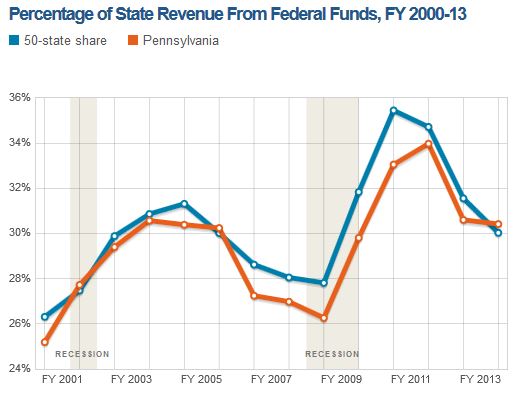
Pew States is out with a new study analyzing fiscal federalism trends in the United States. Based on data from the U.S. Census Bureau’s Annual Survey of State Government Finances they found that 30.0% of state budgets funds come from the federal government. The study states:

As the nation emerged from the Great Recession, federal dollars made up a bigger proportion of states’ revenue from fiscal year 2009 to 2012 than at any other time in the past 50 years. After peaking at 35.5 percent in fiscal 2010, however, the share fell back within its historical range in fiscal 2013, dropping to 30.0 percent.

Even at 30.0 percent, the federal share of 50-state revenue was above its 10-year prerecession average of 28.5 percent. Federal dollars remained the second-largest source of states’ money, accounting for approximately $513.5 billion of the $1.7 trillion collected by state governments in fiscal 2013.

Pennsylvania ranked 29th with 30.4% of its budget coming from the federal government. Historically Pennsylvania’s share of federal dollars as a percentage of its revenues has been slightly below average.

Pew - PA vs All States Federal Funding

Click here for the report.

Knock, Knock. Governor Wolf Drops In

Pennsylvania Governor Tom Wolf has started his term off with a series of meetings and visits with members of the state legislature. Wolf’s spokesman said he has already visited about 50 members of the legislature with plans for more. In a piece for the Philadelphia Inquirer, Amy Worden and Angela Couloumbis capture some interesting responses from inside the Capitol. Here are a couple:

“You don’t expect the governor of Pennsylvania to walk in when you hear a knock at the door.” Rep. Jordan Harris (D-Philadelphia).

“In a bipartisan way, he’s walking the halls, talking to members – that’s been unheard of in my 15 terms.” and “I’ve served under four governors, there’s never been a governor who went around to offices like this….I think it’s a new way and a new day, and we should recognize that.” Rep. Tony DeLuca (D-Allegheny).

“It was a nice surprise. I think he’s getting out to meet people on their own turf, and trying to establish a rapport, especially with people on the other side of the aisle.” Rep. Glen Grell (R-Cumberland).

Mike McGann of the Unionville Times offered a similar quote: “I was working late one night, my staff had already gone home. And I hear the door to my outer office open and I’m wondering what’s going on. And then my office door opens and it is Gov. Wolf, just coming by to say hello.” Rep. Steve Barrar (R-Delaware).

However, the final quote from the Worden and Couloumbis article sheds light on the potential effectiveness of this tactic in the current political environment:

Drew Crompton, the Senate Republicans’ chief counsel stated “Was it a nice gesture? Yes. But you know this place. . . . There aren’t things you are going to just gloss over because a guy shows up at your door.”

The Western Black Rhino & the Pennsylvania Legislature

by Sarah Cox

Widener University Political Science Major

The Western Black Rhino was considered critically endangered for many years, and just recently has been declared extinct. Endangered species laws are up for debate and voting in congress, and they seriously need to step their game up. The extinction of the Western Black Rhino should be a warning to show if things do not change, we will lose many more species of animals.

The latest update to the list of Threatened Species has more than 60,000 species. 25 percent of the mammal on the list can be extinct in the near future, there are also various plant species under threat of going extinct as well.

There is a bill that is currently seeking approval for the endangered species protection act. The act will require approval of protection proposals by a state regulatory agency. The president of the Pennsylvania Chamber of Business and Industry, said the legislation promotes “accountability, transparency and uniformity.” It gives “all stakeholders, and the general public, an opportunity to weigh in on proposed regulations,” Barr said.

However, the new bill in fact isn’t looking out for endangered species, but it is the number one priority for Marcellus shale drillers. They will try to rush the bill through congress because for them, time is money.

Marcellus Shale lawyers are pushing this legislation in order to run through most of Pennsylvania without any regard for endangered species of fish, animal or plants. These species are obstacles to their wells, frack pits and pipelines as well. They want these species gone. They are going to show little to no regard for the animal life, as they already do for the communities that are in their way as well.

http://triblive.com/news/adminpage/5024218-74/bill-legislation-pennsylvania#axzz2jlQhXTuA

In Pennsylvania: Environment and Business= Teamwork

by Lauren Angelucci

Widener University Environmental Politics and Policy Student

Pennsylvania waterfronts are getting a big confidence boost due to recent proposed tax credits for development nonprofits. The Riverlife Task Force has laid plans to revitalize the shorelines in PA. Results have shown that the $130 million in investments that have gone toward the river fronts has now resulted in $4 billon in adjacent development to the community around the river fronts. The development went towards sports complexes, office buildings, hotels, and even residents. Overall, this means that for every dollar invested to the riverfront projects their has been $30 put towards investment adjustment to the rivers. Legislators are trying to spread this statewide hoping that a $10 million tax credit for developers who donate to Riverlife and other like-force’s will encourage involvement. Though Pennsylvania will take a blow to their yearly revenue it is said that the credits will bring value to the towns and areas the river fronts are in.

The state and business merge in the benefit of the community is the great way to show support statewide. Pennsylvania is a state with a bundle of resources, and preserving them and up keeping them is so important. When business is thriving they are always going to be willing to give back especially if it is benefiting them in a positive light. Even if it takes a little bit of a “blow” to the states revenue, it is taking one factor, and helping two in return. Businesses are given an initiative, and in return the river fronts thrive, and the community thrives. It would be great if this went statewide because then not only one area would be of focus, but thousands of more Pennsylvania businesses would thrive as well. Sometimes the environment is not on the radar of people who have other things going on, so these are the kind of things that need give people who have the funds to support these Task Force’s, the extra push to want to give back and help their environment that surrounds their community.

PA’s Impact Fees: Corporations Try to Shift the Burden Onto Someone Else

by Paul Berger
Widener University Environmental Politics and Policy Student

In PA, it is against the law for companies to shift the burden of an impact fee onto the land owners according to act 13. “A producer may not make the fee … an obligation, indebtedness or liability of a landowner, leaseholder or other person in possession of real property, upon which the removal or extraction occurs.” This means that the companies themselves have to pay these impact fees and the landowners dont have to sacrifice any of their royalties to help pay the fee. Some companies, like Chesapeake Energy and Chevron have found ways around the law and are still requiring landowners to partially pay the fee. They put it in their lease with the landowner that “landowners agree that Pennsylvania impact fees would be deducted from their royalty payments in proportion to their interest.” This means that if a landowner is receiving 15% of the profits, they must pay 15% of the impact fee. As of right now, Chesapeake has said that they have not actually made landowners pay the partial fee. They have found other way to charge landowners, like through post-production costs. I honestly think that this was put in their lease so that sometime in the future when the law has settled down and is somewhat forgotten, the companies could bring up the partial fee and make landowners pay for the partial fee because it is in their lease.